
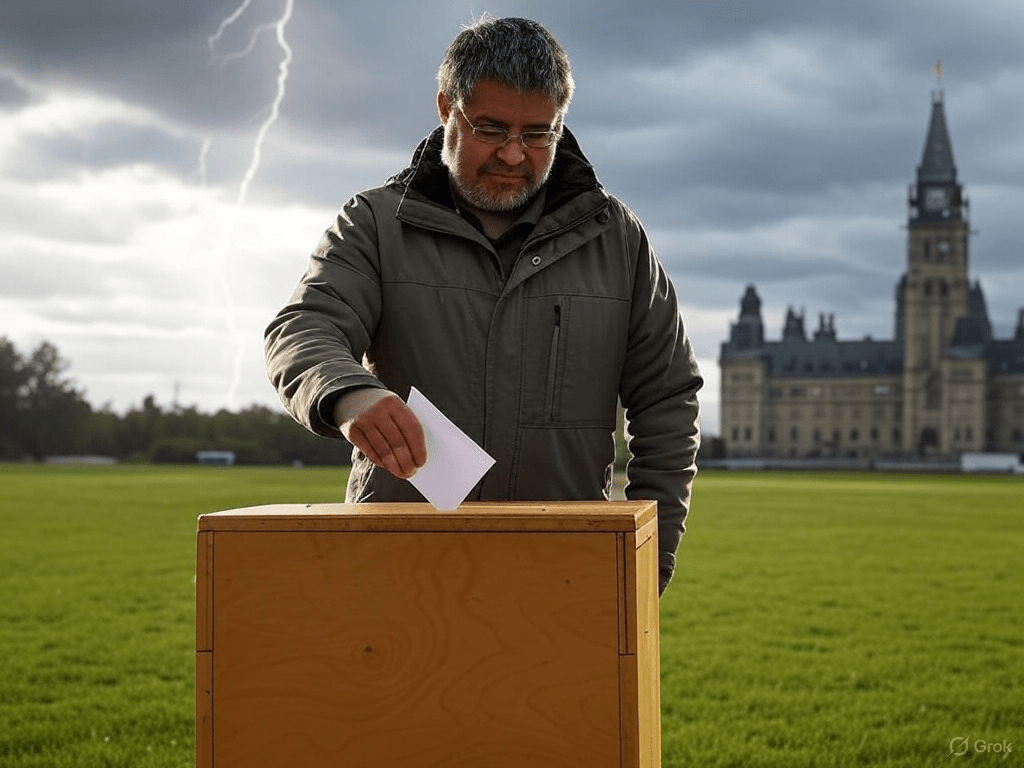
Right now, the remainder of Canada’s eligible voting population is receiving their final opportunity to elect serious change and bring about positive reform in the True North. But will Canada finally wake up and reverse the disastrous course the country set upon almost a decade ago by electing the Liberals to office, or will they continue to indulge in blissful ignorance and lack of self-awareness till the entire nation is totally weakened as a result?
Sadly, the latter option seems to be a looming reality. The former option offers nuances in terms of which candidate or party is best capable of bringing about that desperately-needed change (e.g. the Conservative Party, the People’s Party, independent candidates, etc.); the latter one leaves no room for debate. It is abundantly clear to any sensible person plugged into Canada’s political environment that the Liberal Party and their cohorts in the New Democratic Party will proceed to drive Canada into the ground just as they have done since 2015. Mark Carney has only been in the Prime Minister’s office for a little over a month, yet he has swayed many people’s minds into thinking he is enough of a positive change for the populous. But how much of a change can he really be when majority of his cabinet is made up of all the same people from Justin Trudeau’s cabinet? We are somehow supposed to accept the notion that he will boost the Canadian economy and heal it from the severe damage caused by his predecessor — yet he was Trudeau’s unofficial advisor in 2020 to help formulate a Covid-19 “economic recovery plan.” Did his plan work? It appears not since Canada’s GDP for 2020 contracted 5.4%, which Statistics Canada deemed to be “the steepest annual decline since quarterly data were first recorded in 1961.” Carney then returned to a similar role in September 2024 when he stepped up to spearhead the Liberal Party task force on Economic Growth under Justin Trudeau’s government.
If you’re curious about Canada’s overall economic growth — both recently and throughout the last decade — the latest reports show that GDP growth per capita diminished for the sixth consecutive quarter in Q3 of 2024 but bounced back up again in Q4. The recorded GDP increase for 2024 was a mere 1.4%, and a chart from Visual Capitalist depicting real GDP growth per capita in the third quarter between 2014-2024 ranks Canada below several countries like Mexico, Germany, and Austria. Visual Capitalist cites a 16% increase in Canada’s population during that decade, subsequently reducing our total GDP growth per capita for that time period. Needless to say, Canada’s economy is in a pitiful state, and the Party of Mark Carney and Justin Trudeau has been the propeller of these downturns.
But Carney has tried to distance himself from his Party’s history. In fact, he’s attempted to hijack his opponent Pierre Poilievre’s platform, seemingly embracing campaign promises like creating new pipelines and ending the carbon tax. However, Carney is an expert at speaking out of both sides of his mouth; this was demonstrated when he expressed his goal to institute new pipelines in English, but said in French that he would not impose this plan on provinces that were not willing to go along with it, such as Quebec. And as I clearly explained in this linked blog post, Carney never removed the carbon tax as he led you to believe but instead lowered it to zero, meaning it is still in effect and available to be increased whenever he pleases.
When digging through Carney’s closet, one will also find a few skeletons in there that point to the fact that he will sell out Canada at any point in time that it is personally beneficial to do so. Simply research the relocation of Brookfield Asset Management, an investment firm chaired by Carney during 2021-2025, from Toronto to New York City. This move was announced in late October while Carney was still chair, and such an action can only be perceived as a pre-tariff precaution in the scenario that Trump would win just a few weeks later. Given this information, can Canadians trust Carney to put their interests first when he so readily takes business out of the country — and then denies it later?
This isn’t the first truth Carney has buried on the campaign trail. Following the March 28 phone call with Trump, Carney said that the president “respected Canada’s sovereignty, both in his private and public comments”; yet it was revealed this past weekend that Trump had reiterated his “51st state” idea during that phone call. When Carney was confronted on his failure to disclose this information and his intention to mislead people into the opposite direction, he doubled down and said that “the essence of the discussion and where we moved the conversation to, was exactly what I said.” But his curious entanglements with the US president don’t end there. John Ivison from the National Post reported that, according to a senior source, Carney called Trump a “transformative president” and allegedly warned the president that he would need to “talk tough” about his American counterpart during the campaign. Regardless of whether these comments were genuine or meant to stroke Trump’s ego, Mark Carney is not being honest with the Canadian people about his interactions with Trump. In a surprise to no one, a spokesperson for the Prime Minister’s Office has denied these claims, but the information I have just written proves that their words and denials mean nothing substantive.
Despite Carney’s closeted skeletons and consistently deceptive behaviour, all major polls show the Liberal Party still holding down the lead. While some have balanced out since my last post where I tracked the most recent polling data, the tightest polls show Carney with a +2 point lead, and the most generous indicate a +6 point lead. This leaves a few questions on observers’ minds. Firstly, it’s apparent that Pierre Poilievre is the underdog in this fight; does he have a chance to emerge victorious? Secondly, will the winning party come away with a majority or a minority government? Finally, could this end up in a major polling upset like the unexpected Trump landslide in the US last November?
Readers can speculate many of these answers for themselves, but allow me to weigh in on my speculations for a moment. Several of these polls predicting a Carney win came within a narrow margin of error in projecting the exact results of the last few elections. Unfortunately for conservatives, they do have some credibility to fall back on. But the recent tightening in last night’s projections indicate that Poilievre may have a slight chance. Regardless, the night will likely close with the victor gaining a minority government, but don’t underestimate the potential for Carney to take a majority as initial polls from a month ago indicated.
Whichever party wins, Canada will be in for a rough ride. Though it will inevitably be rougher with Carney, Poilievre is not a sunshine-and-rainbows candidate either. His “dollar-for-dollar” tariffs proposal indicates he lacks the economic acumen needed to see how retaliatory tariffs are hurting Canadian businesses and consumers most, as well as the overall health of the economy. His stance on MAiD (Medical Assistance in Dying, a.k.a. Canada’s federal euthanasia program) is to keep it in place, leading to continued deaths of countless vulnerable Canadians. While he has adamantly opposed a carbon tax, Poilievre has supported a tax credit for carbon emissions — a type of carbon tax in a different form. Poilievre is just a more sanitized liberal. At worst, he could be nearly (but likely not quite) as dangerous to Canada’s wellbeing as the Liberal Party leader. At best, Poilievre is a massive gamble for conservatives who might unintentionally be voting for another flip-flopper like Andrew Scheer or Erin O’Toole. I cannot say which is true; it is every conservative’s personal decision if it’s a gamble worth taking or not. The decision of voting for Poilievre is not as cut-and-dry wrong as the decision to vote for Carney.
By tonight, Canada will largely know the answer to all of these posited questions. After a decade of failed Liberal leadership, it’s hard to believe that a population would vote in Round 4. Yet the populace may surprise us all in the end; but don’t bet your mortgage on it. It might become significantly higher in the years to come.
Cover Image Generated by GrokAI
Discover more from The Culture Clash Blog
Subscribe to get the latest posts sent to your email.
 The Culture Clash Blog
Leave a comment